The short answer
No one can predict how many sizes you will drop. In the STEP 1 trial, average weight loss with semaglutide 2.4 mg was 14.9% over 68 weeks; in SURMOUNT-1, it was 15.0% to 20.9% with tirzepatide over 72 weeks. Individual results varied widely, and how pounds turn into sizes depends on your height, body shape and the brand.
Nobody can tell you in advance how many sizes you'll drop. What you can know is what the large clinical trials report as average weight loss, why individual results spread so widely, and how to plan your purchases so a changing size doesn't drain your budget.
What do the big clinical trials report?
Two of the large trials behind these medications were published in the New England Journal of Medicine. Both compared a once-weekly injection with a placebo in adults who did not have diabetes.
STEP 1 enrolled 1,961 adults with a BMI of 30 or more, or 27 or more with at least one weight-related health condition. Participants took semaglutide 2.4 mg or a placebo for 68 weeks, about 16 months, and both groups also took part in a lifestyle program. According to the study by Wilding and colleagues (2021), average weight loss was 14.9% with semaglutide and 2.4% with placebo.
SURMOUNT-1 enrolled 2,539 adults with a BMI of 30 or more, or 27 or more with a weight-related complication. Participants took tirzepatide at 5 mg, 10 mg or 15 mg, or a placebo, for 72 weeks, about 17 months. According to the study by Jastreboff and colleagues (2022), average weight loss was 15.0%, 19.5% and 20.9% in the three tirzepatide groups, and 3.1% with placebo. At the start, participants weighed about 231 pounds (104.8 kg) on average.
| Trial | Length | Average weight loss, medication | Average weight loss, placebo |
|---|---|---|---|
| STEP 1, semaglutide 2.4 mg (NEJM, 2021) | 68 weeks | 14.9% | 2.4% |
| SURMOUNT-1, tirzepatide 5, 10 or 15 mg (NEJM, 2022) | 72 weeks | 15.0% to 20.9%, depending on the dose group | 3.1% |
Read these numbers for what they are: averages from two separate studies, with different participants, measured at different points in time. They are not a head-to-head comparison, and they don't say which medication or dose suits anyone. Those questions belong with your prescriber.
Why do individual results vary so much?
An average sits in the middle of a wide spread. The National Institute of Diabetes and Digestive and Kidney Diseases (NIDDK) says it plainly: “Results vary by medication and by person.”
The trials show that spread in their own numbers. In STEP 1, 86.4% of people taking semaglutide lost at least 5% of their body weight, 69.1% lost at least 10%, and 50.5% lost at least 15%. Turn that around: about half lost less than 15%, and 13.6% lost less than 5%. In SURMOUNT-1, 85% to 91% of people in the tirzepatide groups lost at least 5%. In the 10 mg and 15 mg groups, 50% and 57% lost 20% or more, which also means many did not.
Percentages hide pounds, too. The same percentage is a different number of pounds for different people. Fifteen percent of 180 pounds is 27 pounds, and 15% of 260 pounds is 39 pounds. That's arithmetic, not a forecast.
And pounds hide shape. Two people who lose the same amount of weight can see very different changes in their clothes, depending on their height, their frame and where their body changes first.
If you want to know what's realistic for you, ask your prescriber or doctor. They know your health history. A trial average doesn't.
Is there a rule for how many pounds equal one dress size?
Not a reliable one. You'll see online rules that turn a fixed number of pounds into one dress size, but clothing sizes aren't defined by weight. They're defined by body measurements.
ASTM International's standard for women's misses sizes, D5585, is titled “Standard Tables of Body Measurements for Adult Female Misses Figure Type, Size Range 00–20.” It lists body measurements for each size, which can be used as a baseline for designing clothes. Brands then publish their own size charts, so the same number can fit differently from one label to the next.
So the number of pounds it takes to change a size depends on:
- Your height. The same weight sits differently on a taller or shorter frame.
- Your body shape. Bust, waist and hips are listed separately on a size chart, and they may not change at the same pace.
- The garment. A stretch knit covers a range of sizes. A tailored piece needs a close match.
- The brand. Each brand's chart is its own.
Men's pants are usually labeled by waist and inseam in inches, which makes changes easier to see. Shirts and jackets still depend on chest and shoulder measurements, which can change at their own pace.
How can you track your size without guessing?
Since sizes follow measurements, a few numbers and a few favorite garments tell you more about what to buy than your weight does.
- Measure every four weeks or so. Bust or chest, natural waist and hips, at the same spots and the same time of day.
- Write down what fits. Next to your measurements, note the size you wear in two or three brands you buy often.
- Pick reference pieces. Choose one pair of pants and one fitted top, and note how they feel each month: snug, right, or getting loose.
- Shop by the chart. Before you order, compare your measurements with that brand's own size chart instead of reordering the size on your last tag.
If measuring yourself feels stressful, skip it. Paying attention to how your reference pieces fit works too.
How should you plan purchases around a changing size?
Plan for the size you're in now, with a small budget set aside for the next one.
- Buy for this season, not a goal size. Clothes for a size you might reach are a guess. Clothes that fit now get worn.
- Put most of your budget into flexible pieces. Knits, pull-on waists, wrap styles and open layers keep working across a change. The guide to what to wear while you're losing weight fast has a full buy-now and wait list.
- Set a per-size budget. Decide ahead of time roughly what you'll spend each time your size changes, so one change doesn't turn into a whole new wardrobe.
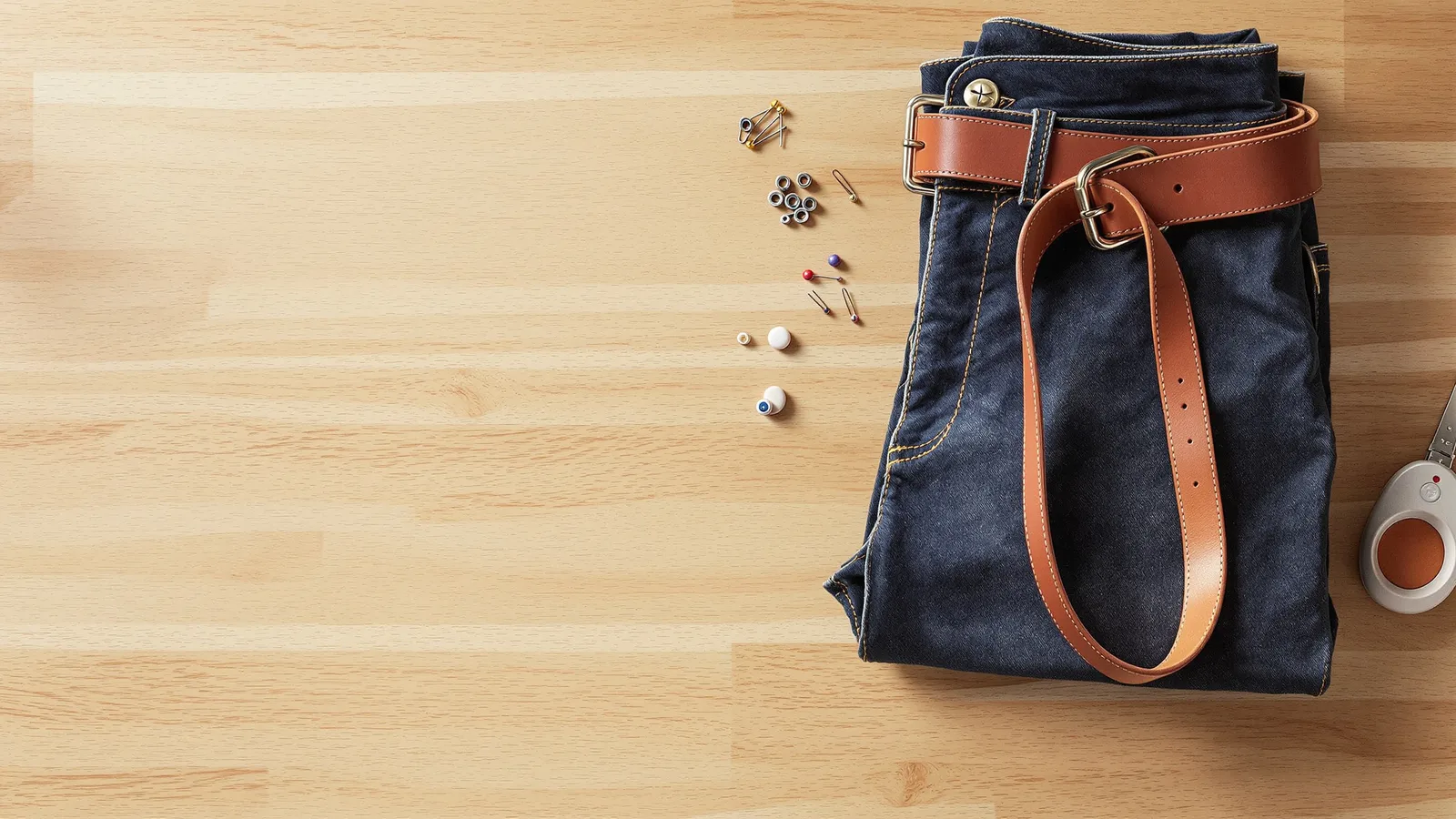
- Bridge the in-between. When pants start to slip, a belt, a clip or a simple alteration can carry you for weeks. See quick fixes for clothes that are too big.
- Wait to invest. Tailoring, good denim, suits and a coat you plan to keep are worth buying once your size has held steady for a few months.
- Move old sizes out as you go. Selling or donating frees up closet space and some money. See what to do with clothes that don't fit anymore.
- Match big buys to the season. When the weather turns, buy only the one or two pieces the new season truly needs, like a coat roomy enough for a sweater, and look secondhand for the rest.
What if your size stops changing, or changes slowly?
Your size might change quickly for a while, then slowly, or not at all for a stretch. Everyone's pattern is different, and it isn't a grade. Any question about your medication or your weight is one for your prescriber.
On the wardrobe side, a pause is useful information. A few months in the same size is your signal that better-made pieces and tailoring are worth the money. It's also a good moment to take stock: keep the pieces you reach for every week, and pass on the ones you never wore.
If you'd like your everyday basics handled while your size keeps moving, Next Size Club sends members a capsule of about 6 everyday basics in their current size. When your size changes, a new capsule ships in the new size, and the old one goes back with a prepaid label. It doesn't sell, prescribe or recommend any medication. It handles the clothes. Here's how membership works.
This guide is general information, not medical advice. Next Size Club does not sell, prescribe or recommend medication. For anything about your treatment, talk to your prescriber.
Questions people ask
Do these trial results apply to people with type 2 diabetes?
Both STEP 1 and SURMOUNT-1 enrolled adults without diabetes, so their averages describe that group. If you have diabetes, ask your prescriber what the research shows for people in your situation.
Did people taking the placebo lose weight too?
Yes, a little. In STEP 1, the placebo group lost 2.4% of body weight on average over 68 weeks, and in SURMOUNT-1 the placebo group lost 3.1% over 72 weeks. In STEP 1, both groups also took part in a lifestyle program.
Why do my tops still fit when my pants don't?
Size charts list bust, waist and hips as separate measurements, and those don't always change at the same pace. So you may wear different sizes on top and bottom for a while. Track each measurement on its own and shop by each brand's chart.
Should I buy clothes in my goal size now to save money?
It usually costs more than it saves. You can't know in advance which size you'll reach or how a given brand will fit you when you get there. Buy for the size you're in, and keep part of your budget free for the next change.
Sources
- New England Journal of Medicine — Wilding JPH et al., Once-Weekly Semaglutide in Adults with Overweight or Obesity (STEP 1), 2021, PubMed record
- New England Journal of Medicine — Jastreboff AM et al., Tirzepatide Once Weekly for the Treatment of Obesity (SURMOUNT-1), 2022, PubMed record
- NIDDK (National Institutes of Health) — Prescription Medications to Treat Overweight & Obesity
- ASTM International — D5585-21, Standard Tables of Body Measurements for Adult Female Misses Figure Type, Size Range 00–20